

The Revenue Cycle & Claims Intelligence module is where DecisionDoc transforms clinical documentation into financial precision.
By embedding billing automation directly inside the EHR workflow, the platform ensures that every encounter, code, and claim is validated for compliance before submission—eliminating costly denials and accelerating reimbursement cycles.
DecisionDoc connects providers, billers, and payers through a unified, FHIR-enabled infrastructure, automating the full claim lifecycle—from eligibility verification and charge capture to denial tracking and revenue auditing—while maintaining complete transparency and audit traceability.

In many practices, billing operates downstream of care delivery—introducing errors and delays through handoffs and manual coding.
DecisionDoc eliminates this disconnect by integrating RCM directly into clinical operations, ensuring that every documented service, diagnostic, and procedure translates immediately into an accurate, validated transaction.
At the center of this process lies DecisionDoc’s patented validation algorithm, which confirms medical necessity and code integrity before any claim is filed.
This unified structure provides real-time visibility into a practice’s financial health, enabling administrators to track claims, detect underpayments, and maintain proactive compliance with payer rules.

Eligibility Verification
The system validates insurance eligibility and plan coverage instantly at patient check-in using HIPAA EDI 270/271 transactions.
Providers are alerted if prior authorization or referral documentation is required.
Charge Capture and Coding Accuracy
CPT and ICD codes generated by the Encounter Intelligence module flow seamlessly into the billing queue.
DecisionDoc’s patented algorithm cross-references payer policies, LCD/NCD rules, and clinical evidence to confirm medical necessity and eliminate submission errors.

Claim Creation and Submission
Claims are automatically populated into CMS-1500 forms or their electronic equivalents (837P)—complete with modifiers, rendering-provider details, and digital signatures.
Batch or individual submissions are managed directly from the billing dashboard.
Adjudication Tracking and Reconciliation
EOBs and ERA (835) remittance files are automatically matched to claims, marking them as Paid, Partially Paid, or Denied.
Adjustments and rework notes are recorded in real time and retained for audit reference.
Denial Management and Appeals
If a denial occurs, DecisionDoc identifies the root cause—whether coding, authorization, or documentation-related—and provides a pre-formatted correction workflow.
The patented algorithm re-validates medical necessity during resubmission, while the audit trail preserves the full communication history for compliance review.
Revenue Analytics and Forecasting
Custom dashboards display collection rates, AR aging, payer performance, and underpayment detection—giving administrators real-time insight for strategic decision-making.
Because DecisionDoc’s RCM functions operate within the same architecture as its Encounter and Intelligence modules, financial accuracy begins at the point of care:

Algorithm-Verified Medical Necessity: Each billed procedure is supported by documentation validated through the patented DecisionDoc framework.

Coding Consistency: CPT, ICD, and HCPCS codes link directly to verified clinical findings.

Auto-Superbill Generation: All patient services—labs, procedures, and visits—are itemized into editable superbills.

Compliance-Linked Submission: Each claim undergoes algorithmic and oversight validation for completeness before submission.
This eliminates redundant data entry, strengthens communication between clinical and billing teams, and ensures payer-ready precision from the outset.


DecisionDoc integrates with the Clinical Speed platform to perform forensic-level analysis of payer activity and underpayment patterns.
By cross-referencing claims against contract terms, the patented algorithm identifies discrepancies, validates allowable payments, and documents recovery actions—all within a compliant, auditable framework.


Every process in DecisionDoc’s RCM module is designed to meet or exceed federal and payer regulatory standards:
HIPAA Privacy & Security Rule
HIPAA EDI Transactions (X12)
CMS & AMA Coding Standards
HITECH Act
OIG Compliance Guidance
AES-256 encryption at rest, TLS 1.3 encryption in transit
Full support for 270/271 (eligibility), 837P (claims), 835 (remittance)
CPT, ICD, and HCPCS libraries updated quarterly
Breach-notification and audit - readiness protocols
Audit trails, separation of duties, and algorithm-based validation controls
All transactions are timestamped and stored for the federally required retention period, ensuring continuous audit readiness.
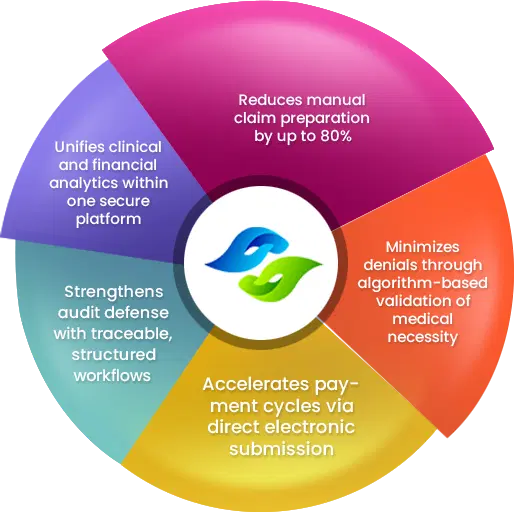
DecisionDoc’s visual dashboards provide real-time insight into practice revenue and operational performance:
Each view is permission-controlled to comply with HIPAA’s minimum necessary access principle.

Together, these components form a continuous, compliant revenue ecosystem—where validated documentation flows seamlessly from care to reimbursement.
DecisionDoc’s Revenue Cycle & Claims Intelligence module combines its patented medical-necessity validation algorithm with selective AI oversight to redefine financial performance in healthcare.
It merges operational precision with the transparency required by regulators and payers alike—creating a financial ecosystem built on trust, efficiency, and verified integrity.